Connect with us

Tech

The 10 Best AI Text-to-Video and Face Swap Tools of 2026

Published

on

Ai

In 2025, AI generated videos will be a very different proposition than they were just a year earlier. The tools cease to be novelty-driven demonstrations and are realistic systems capable of delivering real content on real deadlines. Weeks of systematic experimentation in the marketing videos, product explainers and social formats reduced the list to ten platforms that continue to perform. These items are based on the reliability, quality of output, ability to control creativity and the ability of a tool to integrate into a professional workflow without causing friction. 

These are the most promising AI text-to-video and face swap tools to use in case you are picking one platform to spend time and budget on this year.

Best Tools at a Glance

Tool Primary Strength Modalities Platforms Free Plan
Magic Hour Text-to-video and face swap Video, image, audio Web Yes
Runway Cinematic generation Video, image Web Limited
Pika Short-form creativity Video, image Web Yes
Synthesia Training and corporate Video, audio Web No
HeyGen Avatar explainers Video, audio Web Limited
Luma AI Realistic motion Video, image Web Limited
Kling AI High-fidelity scenes Video Web Limited
Kaiber Music-driven visuals Video, image Web Yes
DeepBrain AI AI presenters Video, audio Web Limited
Colossyan Instructional video Video, audio Web Limited

1. Magic Hour

The reason is that Magic Hour is the most balanced and reliable platform that I tried. In several formats, it also provided similar results without having to retry a lot or even to do immediate fine-tuning, something that is important when you are producing content at scale. 

The Magic Hour text-to-video workflow is intended towards structured creation. The scenes are arranged in story sequence, the pace is deliberate and the characters are consistently pictorial. The platform is focused on clarity and control rather than flashy effects, making it an ideal choice when it comes to marketing and demos as well as educational content. 

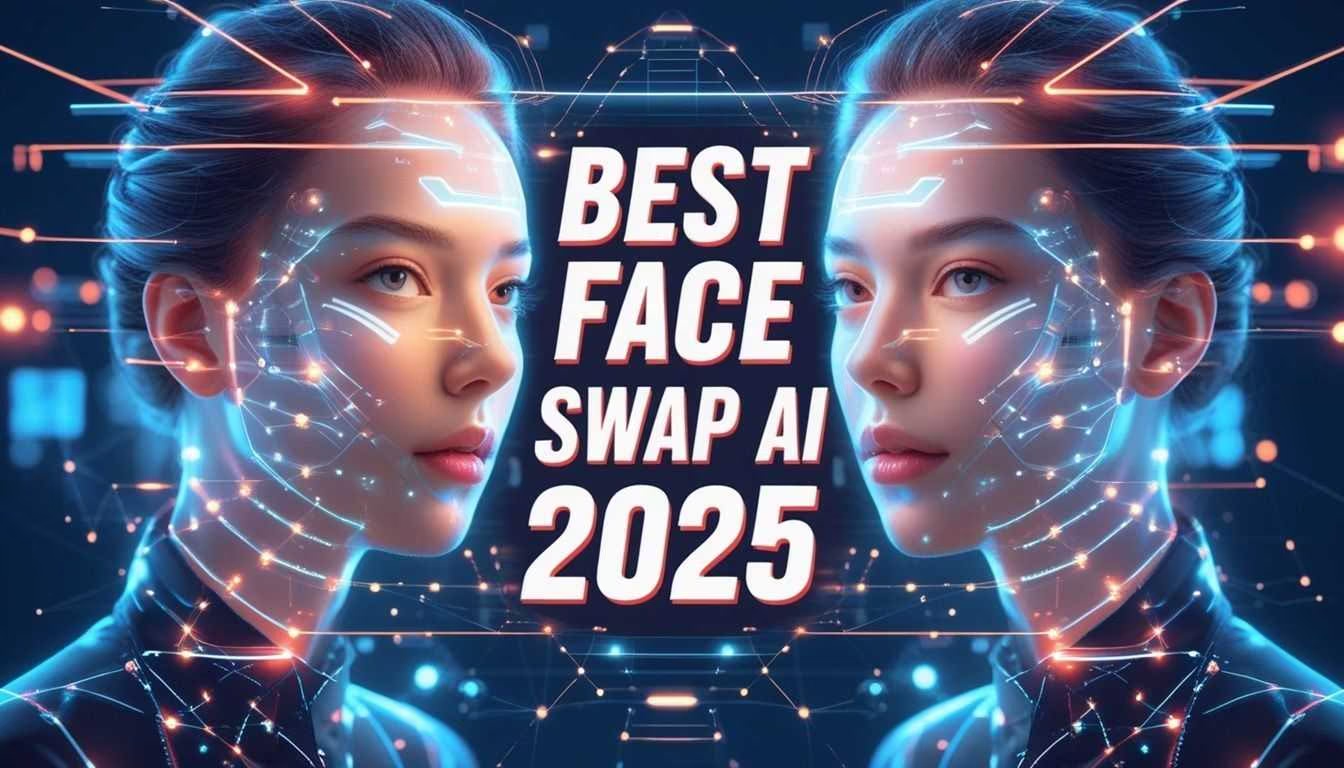
In another workflow, Magic Hour enables creators to swap faces in a video that have good temporal resolution. The facial alignment does not give in to movement, variation in light, and expression. This enables the feature to be used in localization, anonymized demonstrations, and creative storytelling as opposed to novelty edits.

Pros:

  • Reliable prompt adherence 
  • Strong scene consistency 
  • High-quality face swaps 
  • Fast generation speed 

Cons:

  • Limited timeline-level editing 
  • Best results require structured prompts 

In case you require a single tool that will succeed in a variety of AI video-related tasks, Magic Hour is the most reliable choice this year.

Pricing: Free, Creator: it’s $15/mo for monthly and $12/mo for annual, Pro: $49/month, etc).

2. Runway

Runway remains the frontier of film. It has its generative models that are very good at dynamic movement, camera movement, and stylized images which are more film-like than marketing assets.

Pros:

  • Industry-leading visuals 
  • Advanced motion generation 
  • Strong creative flexibility 

Cons:

  • Less predictable results 
  • Higher learning curve 

Runway best suits creators who are focused on visual effect rather than repeatability.

Pricing: Limited free plan; paid usage tiers.

3. Pika

Pika emphasizes time saving and convenience. It is tuned to short-form and experimental data in which iteration is more important than accuracy.

Pros:

  • Very easy to use 
  • Fast experimentation 
  • Free plan available 

Cons:

  • Inconsistent long-form output 
  • Limited structural control 

Pika is a creative person who works best in the beginning of the process.

Pricing: Free with limits; paid upgrades available.

4. Synthesia

Synthesia is designed to communicate on an enterprise-level. Its avatars are consistent, business-like, and made to be clear and not realistic.

Pros:

  • Reliable avatar performance 
  • Multilingual support 
  • Scalable workflows 

Cons:

  • Rigid visual style 
  • Limited creativity 

Synthesia is a good option for training and onboarding.

Pricing: Subscription-based, no free plan.

5. HeyGen

HeyGen makes the videos led by the presenters simple. Script-to-video processes are rapid and predictable.

Pros:

  • Natural lip sync 
  • Simple interface 
  • Brand customization 

Cons:

  • Narrow use case 
  • Limited visual variety 

HeyGen suits the talking-head material.

Pricing: Limited free access; paid plans for exports.

6. Luma AI

Luma AI is an AI-powered company that focuses on realistic motion and 3D-aware video generation, which makes the output seem like it exists in physical space.

Pros:

  • Strong motion realism 
  • Photorealistic results 
  • Innovative capture tech 

Cons:

  • Less control over narratives 
  • Learning curve 

Luma is best when his realism is needed.

Pricing: Limited free tier; paid plans available.

7. Kling AI

Kling AI provides amazing visual fidelity and the existence of long scenes, especially in cinematic scenes.

Pros:

  • High visual quality 
  • Stable long scenes 
  • Strong detail retention 

Cons:

  • Slower generation 
  • Limited access 

Kling has a future and is yet to grow up.

Pricing: Limited availability pricing.

8. Kaiber

Kaiber is intended to be used with music-based and abstract visuals, which is why it is widely used by artists and musicians.

Pros:

  • Audio-reactive visuals 
  • Creative flexibility 
  • Free tier 

Cons:

  • Not suited for narratives 
  • Limited control 

Kaiber is shining in the field of art.

Pricing: Free plan with paid upgrades.

9. DeepBrain AI

DeepBrain AI targets AI presenters and informational video content.

Pros:

  • Professional avatars 
  • Clear speech synthesis 
  • Business-focused tools 

Cons:

  • Limited creativity 
  • Presentation-heavy outputs 

It is ideal in informational applications.

Pricing: Limited free access; subscription plans.

10. Colossyan

Colossyan focuses on instructional and in-house video communication, which has a clean and predictable workflow.

Pros:

  • Easy onboarding 
  • Consistent outputs 
  • Team collaboration 

Cons:

  • Basic visuals 
  • Limited customization 

Colossyan is not creative, he is practical.

Pricing: Subscription-based with trial access.

How We Chose These Tools

All platforms were experimented with the same prompts, similar video durations, and real-life experiences like ads, demonstrations, and explanations. I considered the consistency, speed, usability, and the integration of each tool into a workflow of a professional.

Market Landscape and Trends

The 2025 movement is apparent: consistency rather than innovation. Consistency over time, natural movement and predictability in output have become more important than glittering demos. The use of multi-tool modular workflow is becoming popular.

Final Takeaway

The best overall balance is provided in Magic Hour. Runway and Kling are creatively oriented, Synthesia and Colossyan are training oriented and Pika and Kaiber are experimentation oriented. The most appropriate one depends on your working process yet testing is necessary.

FAQ

  1. Which AI video tool is best in 2025? The most balanced one is Magic Hour. 

Are face swap tools ethical? Yes, when used with consent. 

  1. Are these tools used in place of editors? 

No, but they save the production time drastically. 

  1. Do they make these tools friendly to beginners? 

A majority of them can be studied without significant learning. 

  1. Can they be tested free of charge? 

Some of the tools have free plans which are only limited.

Continue Reading

Categories

Trending