
Blog
A Busy Person’s Study Stack: Turning Reading Time into Remembering Time

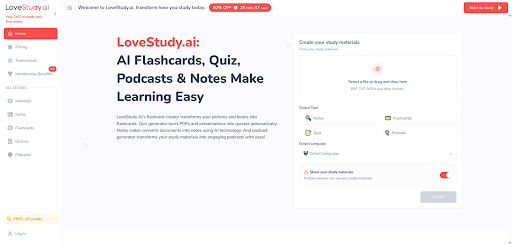
If your learning time is limited—between work, family, and whatever else you’re juggling—your real enemy isn’t difficulty. It’s decayed. You read something on Monday, feel smart on Tuesday, and by Friday it’s gone. That’s why I’m interested in tools that compress the “turn knowledge into something repeatable” step. When I looked at LoveStudy.ai’s AI Flashcards, the appeal wasn’t hype. It was the promise of a simple pipeline: upload what you already have (PDFs, docs, slides, even pictures of notes) and generate flashcards, quizzes, structured notes, or podcast-style audio.
That’s a different proposition than “ask an AI a question.” It’s about changing the format of your materials so they’re easier to rehearse.
The Problem: Reading Feels Productive Even When It Isn’t
A lot of self-learners fall into a predictable loop:
- Read articles, papers, chapters
- Highlight and bookmark
- Feel progress
- Forget most of it
- Repeat with new material
The loop is comforting because it’s low friction. But it’s not optimized for retention. If you want knowledge to stick, you need some form of retrieval practice—forcing your brain to pull the idea out without looking.
Flashcards are one of the simplest retrieval tools. The problem is making them.
What LoveStudy.ai Claims to Solve
LoveStudy.ai positions itself as a “study assistant” with multiple tools:
- Flashcards generated from PDFs, presentations, documents, and even pictures of notes
- Quizzes generated from text, handwritten images, PDFs, or DOCX
- Notes generated from PDFs and lecture content
- Podcast generator that converts text into audio
For a busy learner, the main win is not that these exist—it’s that they’re all generated from the same source material. One upload, multiple study modes.
A Practical “No Willpower Required” Workflow
Here’s a workflow that fits a realistic schedule:
1. Monday (10–15 minutes): Convert
- Upload the PDF/article/notes.
- Generate notes first to confirm structure.
- Generate flashcards next.
2. Tuesday–Thursday (5–8 minutes/day): Drill
- Review flashcards in small chunks.
- Flag confusing cards (don’t fight them; fix them later).
3. Friday (10 minutes): Pressure test
- Generate a quiz from the same material.
- Use wrong answers to identify weak areas.
- Replace vague flashcards with sharper ones.
This is not “effortless.” But it reduces setup friction enough that you can maintain the habit.
A Clear Comparison: What You Gain and What You Give Up
| Comparison Item | LoveStudy.ai | Reading + Highlighting | Generic AI Chat | Anki (Power User) |
| Turns materials into recall practice | Yes | No | Not reliably | Yes |
| Works with PDFs/slides/photos | Yes (platform claims) | Yes (as reading) | Yes (but unstructured) | Yes (but setup-heavy) |
| Time to start | Low | Low | Low | Medium–High |
| Best for | Busy learners converting existing material | Exposure and familiarity | Clarifying questions | Long-term mastery |
| Main limitation | Output needs review; may take iterations | Retention is weak | Not “drill” by default | Learning curve |
This shows the trade-off honestly: LoveStudy.ai tries to sit between “too passive” and “too complex.”
What I Noticed About the Platform’s Design Choices
Even without deep customization, LoveStudy AI structure pushes you toward a learning loop:
- upload → output → study → review again
It also includes options that matter for real life:
- language detection / multilingual output options
- sharing toggle (public visibility) which you’d likely keep off for personal notes
- pricing structured around credits and output limits (useful for measuring cost-per-kit)
This makes it feel less like a one-off generator and more like a lightweight learning workspace.
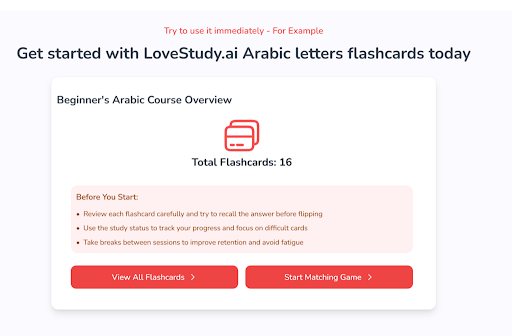
Limitations That Are Worth Saying Out Loud
If you’re using any AI-based generator for learning, these are the constraints that keep expectations realistic:
- Your source material quality matters
Clear text yields better cards than cluttered scans or image-heavy documents.
- You may need multiple passes
The first generation can be too broad. Splitting the source into sections often improves specificity.
- AI can introduce subtle errors
Especially with specialized terminology. Treat outputs like a draft to validate—particularly for certifications, law, medicine, finance, or technical subjects.
- Flashcards can become “definition soup”
If the tool outputs only definitions, you’ll want to edit some into application prompts:- “When would you use X?”
- “What happens if Y is missing?”
- “How does A differ from B in practice?”
These limitations don’t make the tool useless—they just define how to use it responsibly.
A Neutral Reference: Why Retrieval Practice Helps
If you want something non-marketing to ground this approach, retrieval practice is a well-discussed learning strategy in cognitive psychology and health education contexts. Two readable starting points:
- https://pmc.ncbi.nlm.nih.gov/articles/PMC12292765/
- https://pmc.ncbi.nlm.nih.gov/articles/PMC10403443/
You don’t need to become an educational researcher. The takeaway is simple: active recall is usually more durable than passive review.
Who This Is Best For
1. Professionals studying on the side
- certifications
- job interviews
- upskilling in new tools or domains
2. Language learners with real-world materials
- PDFs, transcripts, articles, worksheets
- the ability to generate flashcards from “what you actually read” matters
3. Students who already have resources
If you already have slides and readings, you don’t need more sources. You need a way to practice what’s inside them.
Bottom Line
LoveStudy.ai isn’t a “brain download.” It’s a conversion system: it takes what you already have—PDFs, docs, slides, photos of notes—and turns it into formats that support recall practice (flashcards/quizzes) and flexible review (notes/audio). If you expect to do a quick quality check and occasionally regenerate for better focus, it can make consistent studying feel more achievable—especially when your time is limited and forgetting is the real tax you’re paying.

Watch GT 7 pro: Premium Outdoor Performance, Refined

How to Make Your First Investment Without Overcomplicating It

What Stains Can And Can’t Be removed of your carpet?

Best Codeless Test Automation Tools for Modern QA Teams

Discover Why Montenegro Is Attractive to Investors from Around the World

Who Is Alissa Mahler? The Amazing Story Behind Michael Knowles’ Wife

Robin Stapler Biography: How Alfonso Ribeiro’s Ex-Wife Built Her Own Success

Anton James Pacino: Family, Career, and Secrets About Al Pacino’s Son

Birthday Party Wear Dress: Stylish Outfit Ideas for Every Celebration in 2026

Inside High-Risk Acquiring: Mechanics, Costs, and Where a Specialist Processor Fits

Who Is Kate Garraway New Partner? The Truth Revealed

Brandi Raines Net Worth 2025: Age, Bio, Career, Husband and Children

Betsy Grunch Net Worth 2025: Salary, Career, Husband, and Life Story

How GetAccept’s CPQ Tool is Revolutionizing Sales Efficiency

Salma Shah Biography: Age, Career, Net Worth, Husband and Children

Nomia Iqbal Biography: Age, Husband, Career, Net Worth and BBC Journey

Justin Basini Biography: Net Worth, Success, ClearScore, And His Big Ideas

Kay Crewdson Biography: Age, Date Of Birth, Husband, Children, and Net Worth

Mike Danson Biography: Age, Net Worth, Wife, Children and Full Story

Sophia Wenzler Biography: Age, Date of Birth, Husband, Career Story, and Net Worth
Watch GT 7 pro: Premium Outdoor Performance, Refined
How to Make Your First Investment Without Overcomplicating It
What Stains Can And Can’t Be removed of your carpet?
Best Codeless Test Automation Tools for Modern QA Teams
Discover Why Montenegro Is Attractive to Investors from Around the World
Who Is Alissa Mahler? The Amazing Story Behind Michael Knowles’ Wife
Robin Stapler Biography: How Alfonso Ribeiro’s Ex-Wife Built Her Own Success
Anton James Pacino: Family, Career, and Secrets About Al Pacino’s Son
Birthday Party Wear Dress: Stylish Outfit Ideas for Every Celebration in 2026
Inside High-Risk Acquiring: Mechanics, Costs, and Where a Specialist Processor Fits
-
 News12 months ago
Who Is Kate Garraway New Partner? The Truth Revealed
-
 Net Worth1 year ago
Brandi Raines Net Worth 2025: Age, Bio, Career, Husband and Children
-
 Net Worth1 year ago
Betsy Grunch Net Worth 2025: Salary, Career, Husband, and Life Story
-
 Business8 months ago
How GetAccept’s CPQ Tool is Revolutionizing Sales Efficiency