Tech
The Best Lyric-to-Song Shortcut for Creators Who Don’t Want a DAW with Diffrhythm AI
Published
2 days agoon
By
Admin
If you have ever finished a set of lyrics and then stopped—because the next steps feel like a different profession—you are not alone. Writing words is one kind of creativity; producing a listenable track is another. The gap is where ideas quietly die: the melody stays in your head, the arrangement never arrives, and your “almost-song” never becomes something you can share.
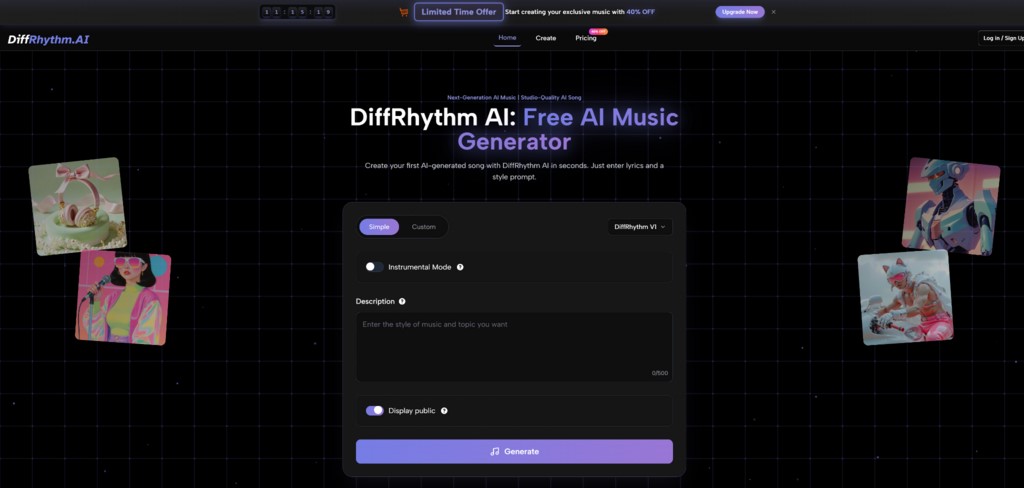
That is why I started testing tools like Diffrhythm AI in the first place. Not to replace musicianship, but to reduce friction. In my own runs, it felt less like “press a button, get a hit,” and more like a fast demo room where you can audition directions—quickly enough that you keep your momentum.
The Problem Most Lyricists Don’t Say Out Loud
The hardest part is not inspiration. It is a translation.
You can describe the song you want—“warm, bittersweet, late-night drive, chorus lift, intimate vocal”—but turning that into sound usually requires at least one of these:
- Production skills (DAW, instruments, mixing, arrangement).
- Money (session musicians, producers, studio time).
- Compromise (generic backing tracks that don’t fit your lyric’s emotional arc).
The result is predictable: you either delay the song indefinitely, or you publish something that does not match what you imagined.
Why This Gets Worse When You’re Trying to Ship Content
If you create regularly (short videos, social posts, indie games, marketing assets), the demand is not “one perfect song.” It is “consistent output.” Under that pressure, you do not need an orchestra. You need a reliable way to get from idea to audio without losing your original emotion along the way.
A Different Lens: Treat It Like a Demo Engine, Not a Magic Machine
Diffrhythm AI makes more sense when you treat it as a structured exploration tool. The best value is not “one generation.” It is “many fast attempts,” because iteration is where you regain control.
In my tests, the second and third generations are often where things click—because you learn how to communicate rhythm and mood in a way the model follows more consistently. That is a very human pattern: you give clearer direction after hearing what “unclear direction” produces.
A Useful Mental Model
Think of your lyrics as the screenplay.
Think of your style prompt as the casting call.
Each generation is an audition.
Some auditions miss the role. Some surprise you. A few reveal a version of the song you did not know you were aiming for.
What This Changes Emotionally
When the feedback loop is short, you stop protecting the first idea. You start improving the idea. That is a subtle shift, but it matters: it turns “perfection paralysis” into “creative steering.”
How to Get Better Results Without Becoming Technical
You do not need music theory to guide outcomes, but you do need to structure your inputs like a songwriter, not a poet.
Write Lyrics That Signal Structure
A practical approach that worked well for me:
- Verse: longer lines, more story detail.
- Chorus: shorter lines, repeated phrases, emotional payoff.
- Bridge: a contrast in tone or imagery, then return.
Even if Diffrhythm does not require labels, your formatting still influences how coherent the output feels.
Use Style Prompts That Describe the “Mix of Feelings,” Not Just the Genre
Broad genres can be interpreted in too many ways. The prompts that felt more stable usually included:
- Mood: intimate, triumphant, melancholic, playful.
- Energy: slow build, steady groove, big chorus lift.
- Palette: piano-led, guitar-driven, synth textures, cinematic strings.
- Vocal vibe (if applicable): soft, airy, powerful, warm.
This is less about “telling the model what to do” and more about removing ambiguity so it has fewer wrong directions to choose from.
A Small Trick That Improved Clarity
When I rewrote crowded lines into cleaner syllable patterns, the vocal phrasing often sounded less strained. If a line feels hard to speak naturally at a steady pace, it may also be hard to sing cleanly in a generated performance.
A Comparison That Focuses on Real Workflow Differences
What you choose depends on your bottleneck: skill, time, or control. Here is a comparison framed around that reality.
| Comparison Item | Diffrhythm AI (Lyric-to-song workflow) | DAW Production | Stock Music Libraries | Clip-based AI Music Tools |
| Best for | Turning lyrics into a full-song demo quickly | Precise composition, editing, mixing | Fast background tracks | Quick mood sketches |
| Typical output | Song-shaped result (lyrics + music direction) | Anything you can build | Polished, but generic | Often short clips or loops |
| Control style | Prompt + lyric structure steering | Full control, high effort | Low control | Medium control, often fragmented |
| Time-to-first-audio | Fast, encourages iteration | Slow at first | Immediate | Fast, but may require stitching |
| Quality ceiling | Can be surprisingly strong, varies by run | Highest with skill/time | Consistent but not personal | Variable; structure can be a challenge |
| Main limitation | May take multiple generations for “exact” vibe | Steep learning curve | Lacks uniqueness and lyric alignment | Coherence across a full song can be harder |
Where Diffrhythm AI Feels Most Useful
In practice, it fits best when you care about “direction” more than “final mastering.”
Use Case 1: You Have Lyrics and Need a Shareable Demo
If you want feedback from friends, collaborators, or an audience, a playable demo beats a lyric sheet every time. A demo carries pacing, tension, and chorus payoff—things that are hard to communicate in text.
Use Case 2: You Create Content and Need Music That Matches a Message
For creators making frequent posts, the goal is often emotional alignment: music that matches the story you are telling. A lyric-to-song workflow can be a fast way to make theme-consistent audio for recurring series, intros, or narrative content.
Use Case 3: You Want Options Before You Commit
One of the most practical benefits is selection. You can generate multiple interpretations, then choose the one that best fits your voice or brand identity. That is closer to creative direction than automation.
Limitations That Make the Results More Trustworthy
A credible tool description includes friction. These are the constraints I would plan for:
- Variance is real. Two generations with the same inputs can feel meaningfully different. That can be a benefit (more options) or a cost (more iterations).
- Prompt sensitivity matters. Small phrasing changes can shift arrangement and vocal delivery more than expected.
- Lyric density can reduce intelligibility. If you pack too many syllables into one line, the vocal may sound rushed or less clear.
- You may need several attempts. The fastest path is often: generate → adjust lyrics/prompt → regenerate → keep the best.
- Finishing touches may still be needed. If you are releasing commercially, you may want light editing, leveling, or optional stem-style tweaks depending on what your plan supports.
None of this makes the tool less useful. It just sets the correct expectation: you are directing a system, not ordering a deterministic output.
A Calm Note on “Objective Claims” in AI Music
The broader generative music field is moving quickly, and it is easy for any product page—anywhere—to sound definitive. A healthier approach is to treat strong claims as observations to be tested in your workflow:
- “It sounds more coherent” becomes “in my tests, it held structure more often.”
- “It is more realistic” becomes “the vocals felt less synthetic in these prompts.”
- “It is effortless” becomes “it is faster than my old process, but still iterative.”
If you want a neutral, non-product view of the space, reading survey-style discussions and evaluation work from music information retrieval venues (for example, ISMIR-related publications) can be a good way to understand why control, consistency, and meaning remain difficult even as audio quality improves.
Seasonal Inground Pool Decor Ideas That Work with Your Custom Design
How Salesforce Development Services Drive Digital Transformation
Why You Should Be Concerned About Gums That Recede Over Time
Buying an Existing Business? The Due Diligence Mistakes That Cost Buyers Thousands
Old House, Old Pipes: When Should Australian Homeowners Actually Worry?
Contact Lens Comfort 101: Daily Lenses, Cosmetic Styles and Eye Drops Explained
Why Safety Standards Matter in Demolition Projects
A Simple Way to Enjoy Fresh Air Without the Annoyance
Strategic Brand Monitoring: Integrating Social Listening, Risk Mitigation, and Market Insight
Inside Seiko: How Prospex Watches Are Tested for Real-World Toughness
Who Is Kate Garraway New Partner? The Truth Revealed
Brandi Raines Net Worth 2025: Age, Bio, Career, Husband and Children
Betsy Grunch Net Worth 2025: Salary, Career, Husband, and Life Story
Salma Shah Biography: Age, Career, Net Worth, Husband and Children
Nomia Iqbal Biography: Age, Husband, Career, Net Worth and BBC Journey
Kay Crewdson Biography: Age, Date Of Birth, Husband, Children, and Net Worth
Sophia Wenzler Biography: Age, Date of Birth, Husband, Career Story, and Net Worth
Ági Barsi’s Untold Story: Sister Of Judith Barsi And Her Battle With Cancer
Mike Danson Biography: Age, Net Worth, Wife, Children and Full Story
Where Is Tulip Victoria Khaury Today?: Everything About Tiny Tim’s Only Daughter
Seasonal Inground Pool Decor Ideas That Work with Your Custom Design
How Salesforce Development Services Drive Digital Transformation
Why You Should Be Concerned About Gums That Recede Over Time
Buying an Existing Business? The Due Diligence Mistakes That Cost Buyers Thousands
Old House, Old Pipes: When Should Australian Homeowners Actually Worry?
Contact Lens Comfort 101: Daily Lenses, Cosmetic Styles and Eye Drops Explained
Why Safety Standards Matter in Demolition Projects
A Simple Way to Enjoy Fresh Air Without the Annoyance
Strategic Brand Monitoring: Integrating Social Listening, Risk Mitigation, and Market Insight
Inside Seiko: How Prospex Watches Are Tested for Real-World Toughness
Categories
Trending
-
News4 months agoWho Is Kate Garraway New Partner? The Truth Revealed
-
Net Worth9 months agoBrandi Raines Net Worth 2025: Age, Bio, Career, Husband and Children
-

Net Worth9 months agoBetsy Grunch Net Worth 2025: Salary, Career, Husband, and Life Story
-

Biography9 months agoSalma Shah Biography: Age, Career, Net Worth, Husband and Children