Walk into any music production studio, and the sheer complexity becomes immediately apparent. Mixing consoles with hundreds of channels, racks of processors and effects units, multiple computer screens displaying waveforms and MIDI data, acoustic treatment covering every surface. This environment represents the culmination of decades of technological advancement in audio production—and it’s also a monument to how inaccessible professional music creation has remained for the average person.
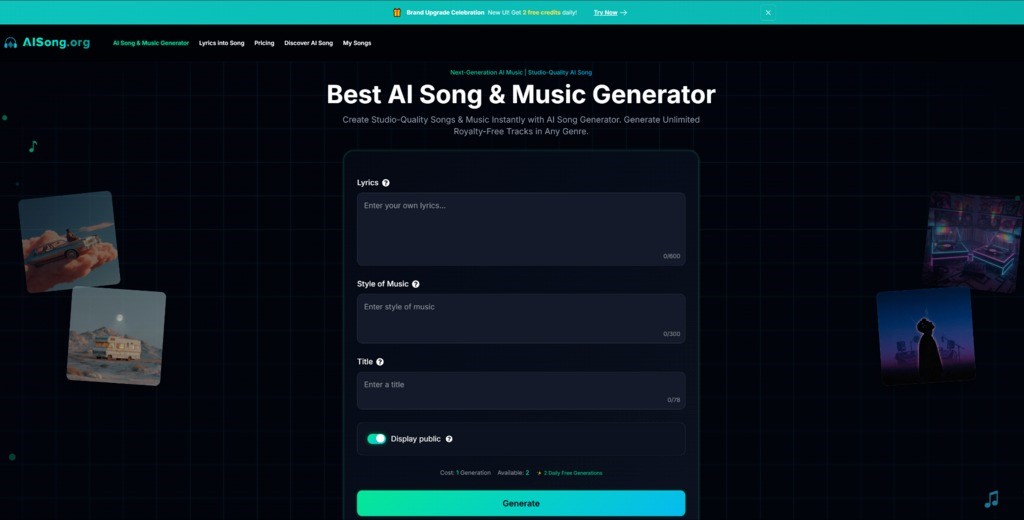
The question isn’t whether these tools are powerful—they absolutely are. The question is whether this level of complexity is necessary for everyone who wants to create music. For a film student needing a soundtrack, a small business owner developing brand content, or a songwriter with lyrics but no instrumental skills, the answer is increasingly clear: there’s now a different path forward, powered by AI music generation tools like the AI Song Generator.
The Gatekeeping Effect of Technical Complexity
When Expertise Becomes a Barrier
Music production has developed its own specialized language—terms like sidechain compression, parallel processing, frequency masking, and MIDI quantization. For professionals, this vocabulary enables precise communication about sonic details. For newcomers, it creates an impenetrable wall of jargon that makes even basic tutorials feel overwhelming.
This technical language barrier extends beyond terminology. The entire conceptual framework of traditional production assumes knowledge that takes years to develop. Understanding why a kick drum needs different EQ treatment than a snare, or how reverb affects perceived depth in a mix, requires both theoretical knowledge and extensive listening experience.
The result is a creative medium where the entry point keeps rising. What could be accomplished with a four-track recorder in the 1980s now requires understanding digital signal processing, plugin architecture, and complex routing schemes. Progress in capability has paradoxically made music production less accessible to beginners.
The Opportunity Cost for Creative Professionals
Consider the filmmaker who needs original music for a short film. Learning music production well enough to create that soundtrack would require hundreds of hours—time that could be spent developing cinematography skills, studying narrative structure, or actually making films. The opportunity cost of acquiring music production skills is simply too high for someone whose primary creative focus lies elsewhere.
This creates a dependency relationship where creative professionals in other fields must either compromise their vision by using generic stock music, allocate significant budget to hiring composers, or accept that their projects will lack the sonic dimension they envision. Each option represents a limitation imposed not by lack of musical ideas, but by the technical barrier to executing those ideas.
How AI Music Generation Changes the Equation
From Technical Execution to Creative Direction
AI music generation fundamentally shifts the skill set required for music creation. Instead of needing to know how to program drums, layer synthesizers, and mix tracks, the creator needs to articulate what they want the music to accomplish emotionally and contextually.
This is a completely different type of skill—one that many creative professionals already possess. A filmmaker knows what mood a scene requires. A marketer understands what energy a brand should convey. A teacher recognizes what atmosphere will enhance learning. These professionals have always had musical intuition; they simply lacked the technical means to express it.
Testing various AI platforms reveals that the most successful users aren’t those with music theory backgrounds—they’re those who can describe emotional states, reference cultural touchpoints, and articulate the purpose music should serve in their project.
The Speed Factor in Creative Workflows
Beyond accessibility, AI generation introduces a speed element that transforms creative workflows. Traditional music production operates on timescales incompatible with many modern content creation demands.
A YouTuber producing weekly videos needs background music for each episode. Commissioning custom tracks would be financially unsustainable. Using the same stock music repeatedly becomes monotonous. Learning to produce original music for each video would consume more time than creating the video content itself.
AI generation resolves this timing mismatch. Music can be created on-demand, matching the pace of content production rather than constraining it. This isn’t just convenient—it enables creative approaches that weren’t previously feasible.
Real-World Applications Revealing New Possibilities
Dynamic Content Adaptation
Social media content creators face a unique challenge: they need multiple versions of the same content optimized for different platforms. A video might need a 15-second version for Instagram Stories, a 60-second version for TikTok, and a 3-minute version for YouTube.
Each version needs appropriately timed music. Traditional approaches meant either awkwardly cutting existing tracks or paying for multiple custom lengths. AI generation allows creating music specifically timed for each version, with consistent musical themes but appropriate duration and pacing for each platform.
Testing this application revealed interesting results. Generating a 15-second “energetic intro music” and a 3-minute version with the same prompt produced tracks that felt related but weren’t identical—sometimes an advantage, sometimes a limitation depending on the project’s needs.
Localized Audio Branding
Businesses with multiple locations face audio branding challenges. A coffee shop chain might want each location to have unique ambient music that still feels connected to the brand identity. Commissioning custom playlists for dozens of locations would be prohibitively expensive.
AI generation enables a middle path: creating variations on a musical theme, where each location gets unique tracks that share underlying characteristics. A prompt like “mellow acoustic coffee shop music with warm, welcoming energy” can be generated multiple times, producing different tracks that all serve the same brand purpose without exact repetition.
This application highlights the AI generation’s strength in creating “good enough” music at scale—not masterpieces, but functional audio that serves specific purposes adequately.
Accessibility for Non-Traditional Creators
Perhaps the most significant impact appears in communities previously excluded from music creation entirely. Individuals with physical disabilities that make playing traditional instruments difficult can now compose music through text descriptions. People in regions without access to music education infrastructure can explore musical creativity without formal training.
An elderly person who always wanted to compose but never had an opportunity can now experiment with musical ideas. A person recovering from injury who can no longer play their instrument can continue creating music through different means. These accessibility dimensions extend beyond economics to include physical, geographic, and circumstantial barriers.
The Quality Question: What AI Does Well and Poorly
Functional Music Versus Artistic Expression
Extensive testing across use cases reveals a clear pattern: AI-generated music excels at functional applications but struggles with artistic expression.
For background music in a corporate video, ambient sound for a meditation app, or placeholder audio during project development, AI generation performs admirably. The music accomplishes its functional purpose—setting mood, filling silence, maintaining energy—without requiring artistic brilliance.
For music intended as the primary focus—a song meant to move listeners emotionally, a composition exploring complex musical ideas, or work requiring cultural authenticity—AI generation shows its limitations. The output tends toward the generic, the predictable, the safe.
This distinction matters enormously for setting appropriate expectations. AI generation isn’t producing the next great album; it’s making functional music accessible to people who need it.
The Consistency Challenge
One limitation that emerges across applications: difficulty maintaining consistency across multiple generations. A project requiring several related tracks—like a video series needing thematically connected intro music—faces challenges.
Generating music with the same prompt multiple times produces variations that sometimes feel cohesive, sometimes feel disconnected. More sophisticated prompting helps: “Create track two in the same style as track one, maintaining the same tempo and instrumental palette but with a slightly different melody.” But even careful prompting doesn’t guarantee consistency.
This limitation particularly affects projects requiring musical continuity—podcast series, video courses, branded content collections. Workarounds exist (generating multiple variations at once and selecting the most cohesive set), but they require additional curation effort.
The Economic Disruption Question
Impact on Entry-Level Music Work
The elephant in the room: what happens to entry-level composers and producers when AI can generate adequate background music instantly and freely?
This concern deserves honest acknowledgment. Certain types of music work—simple background tracks for small projects, basic jingles, generic ambient music—face genuine disruption. Clients who previously might have paid $200-500 for basic custom music can now generate something adequate for free.
However, the market impact appears more nuanced than simple replacement. Many people using the AI generation weren’t previously hiring composers—they were using stock music or going without. AI generation expands the total amount of music being created rather than simply substituting for existing paid work.
Additionally, projects with meaningful budgets still prefer human composers for the expertise, customization, and artistic vision they provide. AI generation seems to be claiming the low-end market that was already underserved rather than displacing established professional work.
The Hybrid Opportunity
Interestingly, some professional musicians are incorporating AI generation into their workflows rather than competing against it. Using AI for rapid ideation, generating multiple melodic options quickly, or creating rough arrangements that get refined with human expertise represents a hybrid approach that combines AI speed with human artistry.
This suggests a future where AI generation becomes another tool in the music production toolkit rather than a replacement for human creativity—similar to how synthesizers didn’t eliminate acoustic instruments but expanded sonic possibilities.
Looking Ahead: The Evolving Landscape
AI Song Maker will continue improving. Current limitations—inconsistent quality, difficulty with specific genres, synthetic-sounding vocals—will gradually diminish. As capabilities expand, the questions about appropriate use and market impact will become more complex rather than simpler.
What remains constant is the fundamental value proposition: AI music generation makes functional music accessible to people who need it but lack the time, resources, or inclination to master traditional production. Whether this represents democratization or disruption depends largely on perspective and position within the music ecosystem.
For the teacher creating educational content, the small business owner developing marketing materials, or the content creator producing regular videos, AI generation solves real problems and enables creative work that wouldn’t otherwise happen. For the entry-level composer trying to build a career, it represents new competition in an already challenging market.
Both realities coexist, and navigating this new landscape requires acknowledging both the opportunities created and the disruptions introduced. The melody of progress has always included both harmonious and dissonant notes—AI music generation is simply the latest verse in that ongoing composition.