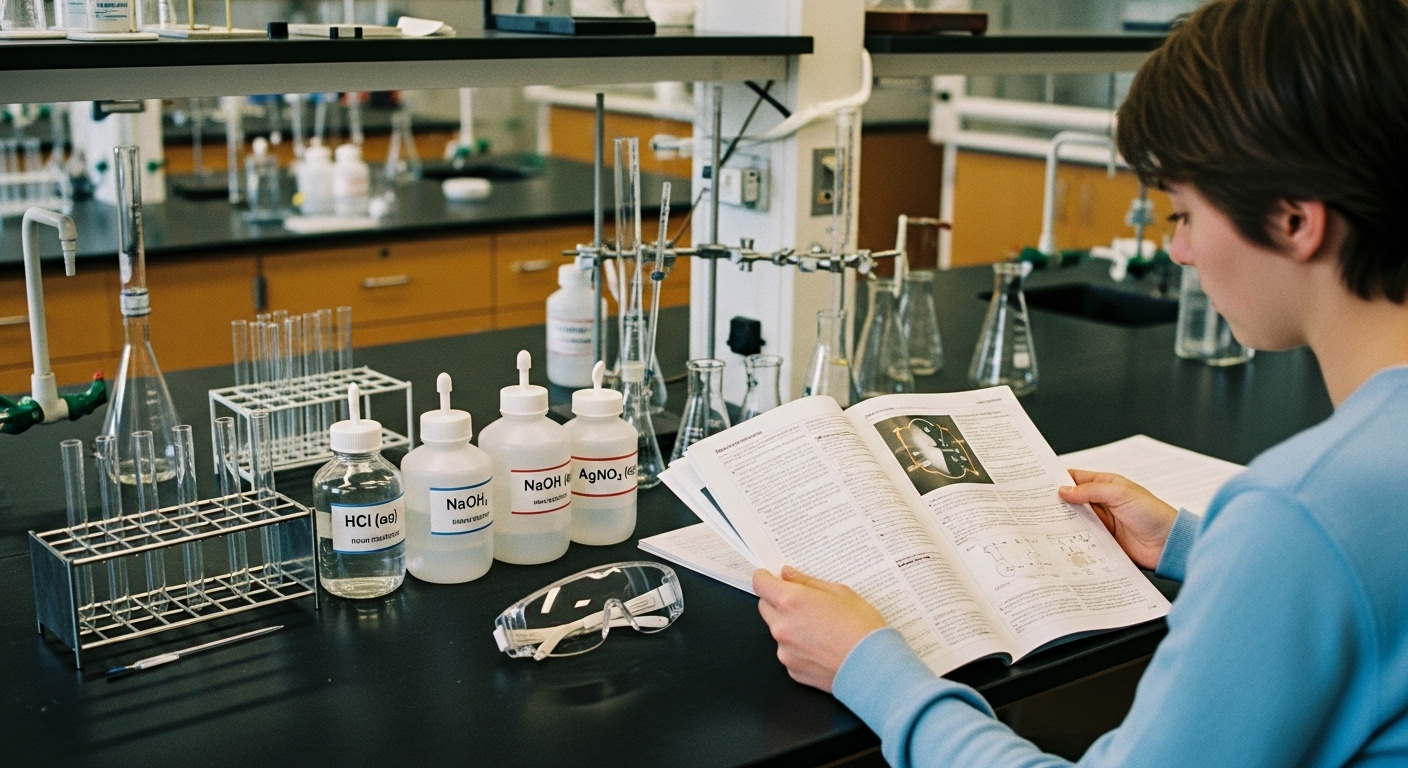
Here you will discover five practical tips to get ready for Abbreviated Qualitative Analysis Scheme experiments. These strategies help you work confidently in the lab, spot key reactions, and complete tasks smoothly.
Modern analytical chemistry has undergone a paradigm shift in its high-stakes world. The days of the six-week, tiring, abbreviated qualitative analysis scheme are rapidly disappearing and strategic, high-yield efficiency has become the new emphasis. The fact is this: the shortened qualitative analysis plan, a simplistic methodology which reduces conventional separation procedures to concentration-based, rational experiments.
The Texila International Journal published an article with the fact that about 80 percent estimated chances of your lab success are predetermined even before you put a finger on a centrifuge. As in 2026, microscale methods and sustainable practices are pushed to the forefront, pre-lab preparation has ceased being a suggestion and has become a requirement.
This article will deconstruct the structure of an effective pre-lab strategy by going beyond memorisation of the flame colours and precipitation charts.
Important Discussions:
- Pre-studies should change to active logic mapping in which you note down procedures with the reason behind that step.lab
- Clean data collection and real-time analysis cannot be achieved without a dynamic and pre-configured results matrix.
- The most effective ways to anticipate difficulties and ambiguous outcomes are by carrying out a mental predictive dry run of your particular unknown.
- The precision required of microscopes is military grade; the arrangement of your bench determines the result and the success of your experiment.
- The quantitative success criteria are predefined, which prevents errors from cascading.
- The final aim is to have the chemistry so internalised that the process becomes an expression of principles of understanding, rather than a series of mysterious steps.
What is an “Abbreviated” Scheme in 2026?
The lengthy multi-session plans for detecting all possible ions in a mixture are a thing of the past. The shortened qualitative analysis plan focuses on high-yield separation points, sometimes grouping them into logical sets to identify key constituents more quickly. With a reliable dissertation writing service, you can turn these results into a structured document that reflects your work and thinking without losing any detail.
The Contemporary Change is Two-Fold
First, it is a shift towards microscale chemistry that drops in the millilitres. It then increases the reaction times and reduces chemical wastage by more than 90 percent, and also drives costs. Second, and more significantly, it requires a Logic Map way of thinking as opposed to a Manual Reader way of thinking.
It is not sufficient to know about the procedure. You have to know the principle. Why does $Ag(NH3)2+ precipitate with a Cl+? The solution is in the complicated ion balance. Why should the solution be acidic in advance of precipitating Group II sulfides? It depends on the concentration of the sulfide ions and the values of the Ksp.
Your pre-laboratory task is to recast the abbreviated qualitative analysis scheme in a sequence of directions (Add 3 drops of NH3) into a chemical reasoning (Add NH3 to decrease [H +], therefore, increasing [S2-] to be higher than the Ksp of CuS).
5 Powerful Pre-Lab Tips for an Abbreviated Qualitative Analysis Scheme You Need to Know
It has been found in research published at Science Direct that students who use the structured pre-lab protocol such as those listed below make fewer errors during the procedure and achieve a 40% higher precision in their results than students who simply skim the manual. Here are a few tips for students:
1. Construct a “Logic-First” Separation Map
Do not just copy the flowchart in the textbook. Re-drawn by hand, labelling each decision point and step of the precipitation process with the active species of the chemical reaction and the critical condition.
-
- Example Annotation: When the Group I chloride precipitation occurs, we should write:
- Agent: $Cl. Critical Condition: Low [H +]. Need not be the case here. Ksp Check: $AgCl$ ($1.8 x 10 -10) is far less soluble than PbCl2 (1.7 x 10 -5)”.
- Kill Step Warning: Failure to remove the level of $Pb2+ here will result in a false positive in Group II.
- Visualising the Math: Right on your map, write the net ionic equation:
- “Ag(aq)++Cl(aq)[?]-AgCl(s) (white precipitate)Ag(aq)++Cl(aq)[?]-AgCl(s) (white precipitate)”
This makes the reaction in your mind something that is there.
2. Design a “Dynamic” Data Results Matrix
Entry into the lab with a blank notebook is a formula to an unorganised data. Prepare a two-column table on each of the possible ions: “Hypothesised Result” and “Actual Observation.”
Rationale
The predictive engagement is imposed by filling in the column under Hypothesised. To confirm the suspected Ni 2 + using dimethylglyoxime (DMG) you would write: Bright red, fluffy precipitate. When you have the real result in view you are not merely entering a colour, you are making a direct comparison with a theory.
The 2026 Digital Edge
Use the PDF template, optimised for tablets. This can be instantly logged, has photo-integrated colours of precipitate, and even AI-based tools to analyse colours of colourimetric analysis can eliminate the subjectivity of, Was that a cherry-red or scarlet? dilemmas.
3. Conduct a “Predictive Dry Run” (Standard-to-Unknown)
Imagine the whole experiment through to the end with using the particular ions in your unknown. This is the best preparation method.
The Simulation
It contains $Fe3+, $Al3+, and $Ba2+. In the shortcut, everything will be kept in solution up to the ammonium sulfide step? No–the presence of hydroxides of Fe 3 and Al 3 will result in their precipitation with the NH 3 /NH4Cl buffer leaving Ba + in a solution. Then the excess of $NaOH will dissolve $Al(OH)3, and not the excess of $Fe(OH)3…
Color Benchmarking
Find your words. Bluishness of Cu(NH3) 4 2+ Is it royal blue or deep azure? Is the starch-iodine complex positive a blue-black or navy? By creating this vocabulary in your head you will not find yourself paralysed by indecision in the lab.
4. Stage for “Military-Grade” Microscale Precision
Microscale increases the risk and efficiency. Contamination is the enemy. Your first line of defence is that of your bench organisation.
The “Group Zones” Arrangement
Divide your working area into groups.
- Zone A: On-clean glassware and sample tubes.
- Zone B: Precipitating reagents (HCl, $H 2 S or thioacetamide, (NH 4) 2 S).
- Zone C: confirmation reagents.
Mise en Place
As a cook, get all the ingredients in place before you start. Put dropper bottles in the same sequence that you use in your logic map. Label centrifuge tubes with a pencil (not a pen!).
The Clean Zone
Use a clean, lint-free cloth (or Kimwipes(r)) to clean micro-spatulas and stirring rods between every single step with a beaker of DI water. One pollutant is a disaster at this magnitude.
5. Pre-Define Your “Success Criteria” (The Ksp Guardrails)
The 2025 Lab Audit of the Journal of Chemical Education reports that more than three-quarters of undergraduate analysis labs now use abbreviated, microscale qualitative analysis plans, with reasons of saving time and money and enhanced student understanding of the principles behind it.
Be aware of the objective completion of a step. This will save you the trouble of dragging along an unfinished precipitation which will plague you later.
Universal Test
Once you think all the precipitation is done and you have isolated the precipitate (by centrifugation) you should always test the supernatant. Put in one drop of the precipitating reagent. In case there is cloudiness, then you have not had total separation. Continue the process.
Logic application
Understanding $K{sp}$. To separate $Pb2 +, $Ag+ and $Hg 2 + in Group 1, you exploit the fact that the solubility of $PbCl 2 rises significantly with temperature. Your success criterion? After washing with hot DI water, the washings should be tested with $K2CrO4$; and should not give any yellow precipitate, ($PbCrO4$) before they are disposed of.
The “In Case of Emergency” Troubleshooting Guide
When time is short and results look odd, consult this rapid diagnostic table.
| Symptom |
Probable Cause |
Immediate Correction |
| No precipitate where expected |
Incorrect pH / Excessive Dilution |
Check pH with litmus; adjust carefully with $NH_3$ or $HNO_3$ dropwise. If diluted, gently evaporate a few drops in a watch glass. |
| “Cloudy” or ambiguous supernatant |
Incomplete Centrifugation / Peptization |
Centrifuge for an additional 60 seconds at a higher speed if possible. For peptized colloids, add a drop of electrolyte (e.g., $NH_4NO_3$) to coagulate. |
| Unexpected Colour Change or Precipitate |
Cross-Contamination / Unanticipated Redox Reaction |
Stop. Start that specific sub-group analysis over with a fresh sample aliquot from your original unknown. Redo with meticulous technique. |
Conclusion
The process of piloting through a short-cut abbreviated qualitative analysis scheme may become, with the right attitude, not an object of apprehension but an act of analysis skill. The intense training described herein involves creating logic maps by creating dynamic matrices and the relevant simulation in your head. For this first you have to set up your workspace and make up the criteria of success. It is an effective way to reduce the activation energy of your lab session.
You are no longer discovering the process in real time. Instead, you follow a pretested plan to achieve a chemical discovery. First-class dissertation writing services in the UK can help connect your experimental observations to your academic analysis so your methodology and results are clearly structured and professionally presented.
Have a critical view of your scheme. And then, unless you can state, without reference to your notes, why the addition of the $NH3$ dissolves the $AgCl$ to give rise to the Ag (NH3) 2 +, but causes the Hg 2 Cl 2 to be subjected to a disproportionation reaction to become black (Hg + HgNH2Cl), then you are not yet prepared to do the lab. Bridge that gap. Internalise the logic. Walk in then and do not merely an experiment, but a demonstration of mastered principles.
Frequently Asked Questions About Abbreviated Qualitative Analysis Schemes
1. Is an abbreviated qualitative analysis scheme acceptable in rigorous academic research or a dissertation?
This is all dependent on the research question and the limits of detection that will be necessary. In the case of first screening (where determining key components in a synthetic reaction is required), or instructing the basics of separation, an abbreviated scheme is an extremely useful method. It is typically desirable due to its speed and reduced consumption of resources.
A complete traditional abbreviated qualitative analysis scheme or even a couple of instrumental techniques (such as ICP-MS) would however be required in a dissertation that purports a complete elemental analysis of an unfamiliar and complicated material, or where trace ions are noteworthy. You should always match your method of analysis with the arguments that you should prove.
2. When shouldn’t I use an abbreviated scheme?
In three major situations, an abbreviated scheme can not be appropriate:
- An abbreviated scheme can be an illegal or scientific requirement, e.g. an environmental test of a regulated contaminant.
- In the analysis of unknown samples of unsolvable complexity or of a large number of ions of similar chemistry which are not resolvable by the abbreviated scheme.
- In cases where the detection limit data required is quantitative or very low. Abbreviated schemes are by definition qualitative and semi-quantitative at best (“present” vs. “absent”).
3. How do I properly cite the procedure for an abbreviated scheme in a lab report?
Use the style that is favoured by your institution (e.g. APA, ACS, MLA). In most cases, you will refer to the lab manual or textbook from which the particular scheme originated. Some of them are:
- APA format: Author, A. A. (Year).
- Title of lab manual (Edition).
- Publisher.
To make certain adaptations, a few words may be added:
The shortened scheme was based on the complete procedure of Smith (2024), with the steps of Groups IV and V cations being omitted. –
Most importantly, have a reference list or a W.C. page. According to the MLA handbook, citing correctly enables others to find and refer to your sources, which is a pillar of writing in academic writing, regardless of the topic of your writing be it chemistry or literary review.