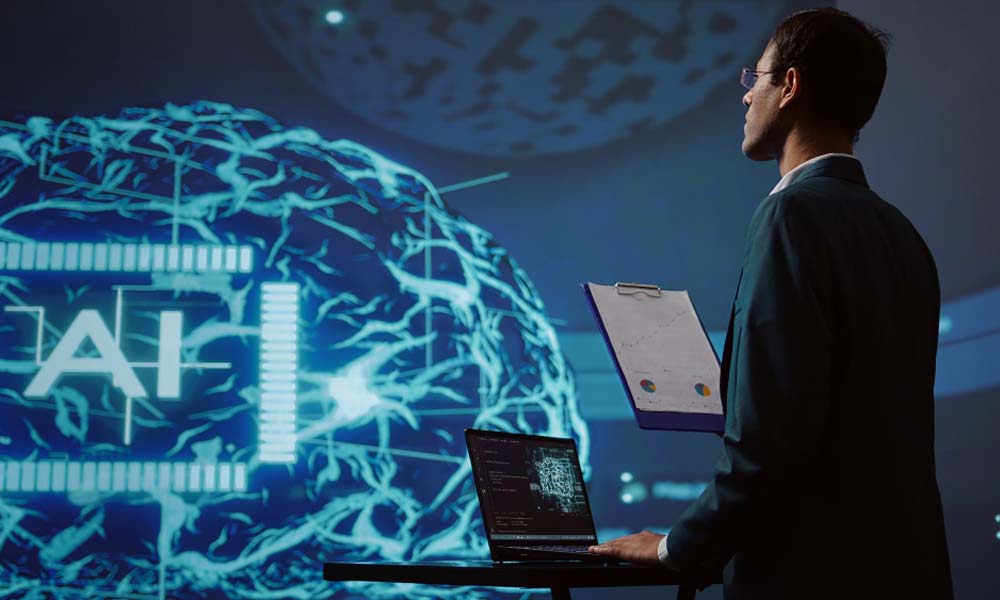
AI Agent Tester is a transformative moment for quality assurance. While achieving scale in automation is the need of the hour for teams as they strive to keep pace with fast-moving modern delivery cycles that call for regular releases and reliable outcomes, a foolproof ability to predict success rates, etc. QA is no longer about verifying if the features work; it is about creating an intelligent, self-learning validation system that deciphers the context, understands the reasoning behind test scenarios and also executes at scale seamlessly. At the centre of this new shift are these anthropology–based AI-driven agents that behave like intelligent digital testers that can observe, interpret and perform.
AI has drastically changed almost every corner of the way we practice software engineering during the past few years. Still, testing was the last function that evolved because it is dependent on interpretation, scenarios and constant updates, which usually require human intervention. Finally, AI agent testers are the answer, as they elevate testing from being a manual and repetitive task to becoming a part of the high-level AI-driven workflow, wherein the systems generate the tests automatically, run them automatically, inspect for failures and surface crucial insights that a human might miss.
Transformations of QA: Intelligent Search Engines As Intelligent Agents
The kind of natural limitations that traditional QA frameworks have hit as software systems become more distributed, dynamic and integrated with external services. For many teams, this means dealing with large test suites, fragile automation scripts, and elongated release cycles driven to a halt by regression roadblocks. AI-driven agents are the game-changer here, adding behavioral intelligence and cognitive processing to the mix where most automation is execution-focused.
Intelligent QA agents are not a coincidence; they are the result of a demand to address core industry problems of test debt, duplication, and impulse defect detection. AI agents, unlike conventional bots that just follow instructions, introduce reasoning, adaptability, and decision-making into the testing lifecycle. They keep track of application behavior, learn from results, and autonomously adjust test coverage. That potential to constantly evolve is why they are the natural next step in modern engineering ecosystems.
What Is an AI Agent Tester?
An AI agent tester is an autonomous software-based entity that makes intelligent decisions that mimic human tester responsibilities, while also leveraging context and strong predictive capabilities. It is much more than just click-replaying or running simple scripts- it thinks through workflows, knows the critical UI and API paths, and adapts to evolving patterns in the application.
These Agents are tightly integrated into development pipelines. They can gaze into system logs, follow user flows from usage-based studies, read natural language requirements, and convert them all to tangible test assets. More crucially, they do not need to be scripted for every individual possibility. Instead, they assess the application context and create reusable and scalable tests.
AI agents are equipped to:
- Comprehend natural language commands and then convert them to test logic
- Find alternate routes or edge cases by exploring apps on your own
- Instant Detection of Defects based on Deviations in Behavior
- As per risk, coverage, and past patterns, identify the test that needs to be executed first
- Reuse existing test cases whenever possible if UI or workflows get changed
This allows QA to remove repetitive tasks, lessen maintenance burden, and direct effort to more impactful work. The result is a system where machines and humans collaborate in an empowered and driven process.
Why Your QA Strategy Needs AI Agents In Its Core Now
Faster release cycles have made the quality engineering more complex and challenging. Slow regression suites, manual exploration, and reactive debugging are not luxuries afforded to teams anymore. AI agent testers serve as the multi-challenge solvers — that is why they are killing it among the engineering teams prepared to enter the next era of AI!
This is partly why they are fantastic in unknown situations, which is another big benefit. Agents can contextualize info they see live – for example, determining that workflow behavior is not as expected, the UI keeps flipping between stable and not, or the data you received is half-baked – and trigger a response without being explicitly told to.
Additionally, AI agents bring consistency. Testers are humane: they are subjective in what they observe, how deep they dive, and are limited by availability. AI agents do not rest; they produce uniform reasoning over time, and they are able to scale with ease in the complexity of the application. This inherent stability is what makes them so effective in situations where there are regular changes or testing across platforms.
They also help to minimize the overhead of updating scripts. Maintaining scripts for every UI redesign or logic update becomes one of the most costliest aspects of automation. Compared to static locators based on the HTML structure of the page, AI agents are much more robust to changes as they understand user intent.
AI Agent Testers Overview: How they work under the hood
Multiple layers in this architecture combine perception, reasoning, plan and execution to be a good AI agent test as well. The idea is to replicate human-like comprehension, but provide machine-level scalability.
Initially, agents listen to the system to be tested. They examine things like the structure of the UI, API replies, network logs, and how users interact. This layer allows the agent to develop a mental model of the system. Then, it runs this model through a reasoning engine to learn how workflows function. This includes navigation paths, form submissions, validations and integration points.
The test objectives are generated by the agent when reasoning starts. It realizes the requirement to conduct the boundary, path coverage, performance and accessibility. These objectives are dynamic instructions written around the ever-changing behavior of the application instead of static scripts.
Lastly, the execution layer deals with the system interaction like clicking the elements, sending an API request, taking screenshots, verifying outputs & analyzing logs. Then layers of continuous learning provide feedback, allowing the agent to do better next time around.
It is this holistic architecture that enables agents to operate autonomously yet augment human supervision.
An Increasing Need For Self-Evolving Test Systems
QA should be more like an intelligent ecosystem and less like a scripted checklist. Microservices, distributed apps, multi-device experiences – no test run is ever identical. AI agents form a constantly changing scenario that forms a dynamic testing model.
Organizations are on the path towards fully automated testing, seeking systems that can proactively detect failures before they emerge into bigger problems, automatically create scenarios that are missing, learn user behavior and optimize the required test coverage without any manual intervention. AI agents meet these expectations through their use of contextual learning and their ability to adapt continuously.
Another issue they can address is test sprawl. That means human tests would progressively become repeated, contradictory, or irrelevant. AI agents can streamline processes, eliminate redundancies, and analyze which tests provide the layer of protection. It keeps the test suite small, effective, and relevant towards product objectives.
In a nutshell, QA is moving away from the static side of planning towards the advance side of execution-and what is driving this new paradigm are AI agents.
Use Cases Which AI Agent Testers are Great At
We see a number of high-impact scenarios where engineering organizations in the real world are adopting AI agent testers. By far the most popular is regression testing, where agents, using intelligent test selection, reduce execution time by orders of magnitude. Agents will not run the entire suite but will prioritize the tests based on code changes, previous failures, and usage statistics.
They are also very effective in exploratory testing. Human testers can explore only a small number of flows, due to resource constraints, while AI agents can independently discover dozens of edge cases in a fraction of the time.
Another one of the most important applications of this is test data generation. A lot of issues stem from invalid or unexpected data conditions. An AI agent can produce the synthetic data that will help identify problem areas ages before they actually reach the user end.
Also, they have the best in cross-browser & cross-device testing. Agents are adaptable to layout differences and behavioral inconsistencies, which means that there is less need to change and reconfigure tests manually for each device or platform.
And, last but not least, AI agents help analyze the root cause. Rather than having to dig through logs or relive a replay of a session, agents detect failure patterns, flag probable causes, and deliver devs actionable summaries of their failures.
What LambdaTest does: Enabling Agentic, Intelligent QA Execution
LambdaTest Agent to Agent Testing is a platform designed to test AI agents – like chatbots, voice assistants or other autonomous AI-based systems – by using other AI agents as testers. Instead of human testers writing fixed test scripts, the platform uses “testing agents” (built using large language models and GenAI-powered frameworks) to automatically generate, run, and evaluate test scenarios against your AI agent.
How it helps and what it does
- It generates large numbers of diverse, realistic test cases – for example, different conversation flows, varied user intents, edge-cases and even adversarial inputs – which may be hard to think of manually.
- It supports multi-modal inputs (text, audio, images, video, docs, etc), which is useful if your AI agent deals with more than plain text.
- It evaluates the agent under test against quality metrics like bias, hallucination, completeness, tone/behavior consistency, security or compliance rules – helping uncover subtle or risky behaviours.
- It scales testing massively: because the testers themselves are AI agents, you can run thousands of scenarios quickly (in parallel, via their cloud execution infrastructure) rather than relying on slow, manual or semi-automated tests.
The Future for QA: Moving into Autonomous Testing Ecosystems
These days, as AI agent testers continue to ripen, the future of QA is adopting a holistic and autonomous environment, where a multi-domain AI agent works in unison in and across the development, security, and monitor layers. One such implies different behaviors, such as a testing agent that executes workflows; another that evaluates performance signals; another that predicts potential failure clusters based upon historical activity data.
Through early adopters of these ecosystems, organizations will decrease bugs, drive innovation faster and gain reliability across the entire area of their products. Instead of finding defects, QA takes on the role of preventing defects – thus creating a proactive approach to quality as opposed to a reactive one.
Over the long haul, human specialists will zero in on methodology, innovative investigation, and moral oversight, while specialists assume control over redundant, low-volume execution errands. This is a complementary model that further drives the efficiency and the product intelligence.
Conclusion
The world of QA is being transformed by automation at a rate never seen before into an intelligent automation era. More complexity in systems and shrinking release cycles require more than just scripted automation, but intelligent agents capable of adaptation to the application and capable of evolving along with the application. This new frontier in testing AI is the AI agent tester – an AI toolkit that merges reasoning, autonomy and predictive power to redefine quality engineering.
With platforms such as LambdaTest offering rich functionality for agent-driven workflows and on-demand execution environments, organizations are better equipped with the underlying building blocks to take these technologies and scale them in their organization. The AI Agent Tester isn′t a fad- it is the catalyst for the future of QA, where automation, intelligence, speed and sustainability are the new definition of success.