Automated lead follow-up is changing the way businesses convert leads. It starts with one simple truth: prospects aren’t the same as they used to be.
Their expectations have shifted. Their patience has decreased. Today’s buyers move fast. They reach out, and if they don’t hear back within minutes, they’ve already moved on.
Most businesses know this. But knowing and doing are two very different things. That’s exactly where AI agents come in and why automated follow-up has become the tool every sales team needs to keep up.
In this article, we’ll show you how to make it work for your business. Let’s get started!
The Fundamentals of Automated Lead Follow-Up
Before we get into the strategy, let’s make sure we’re on the same page about what this system actually is and why it works so differently from everything your team has been doing manually.
Defining the Core System and Architecture
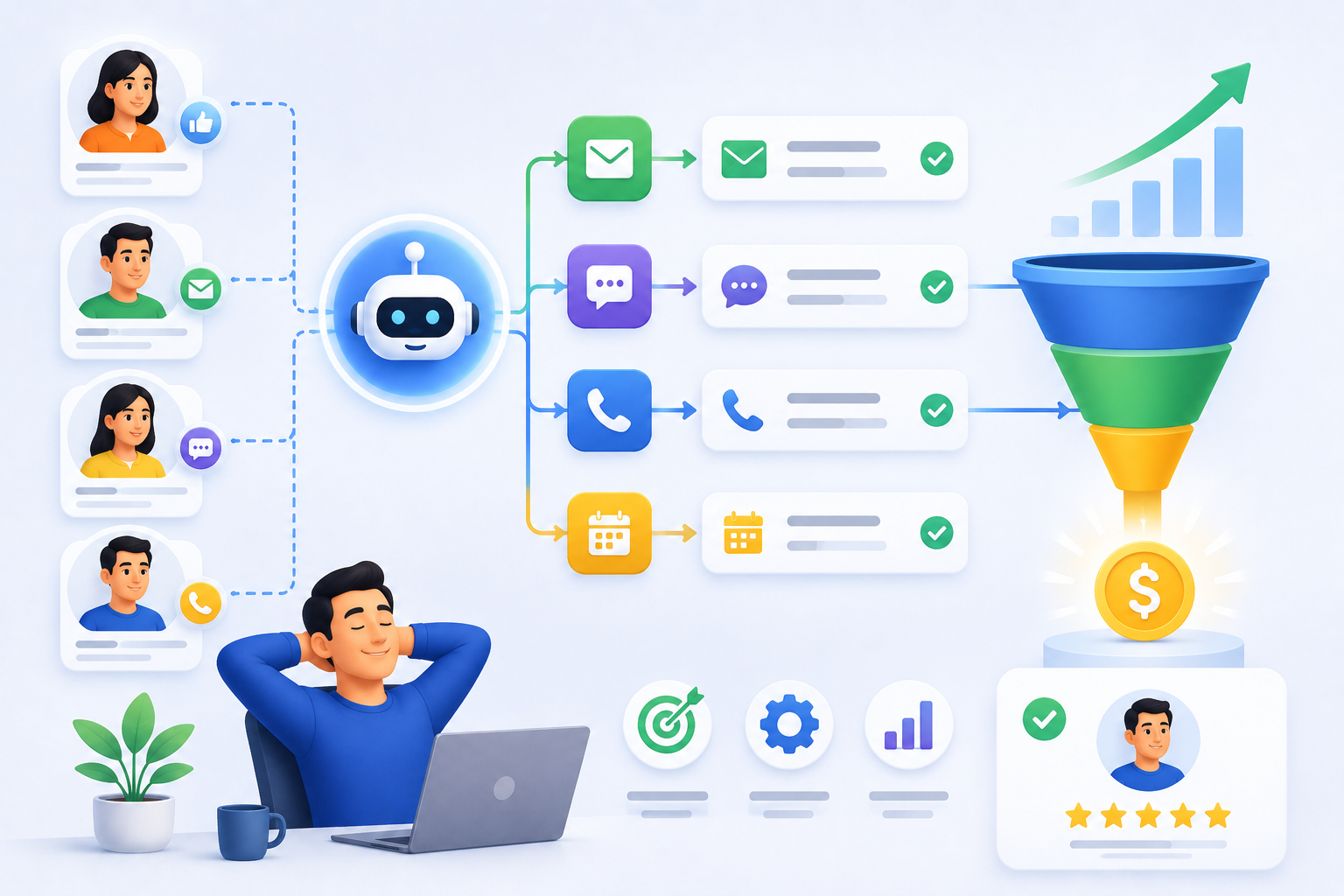
Automated lead follow-up ensures that every prospect receives a timely, relevant response through the most effective channel, all without requiring a human to initiate every single interaction.
It functions as a cohesive ecosystem rather than a standalone tool, built on several key elements:
- Centralized CRM: A single source of truth for all prospect data and interactions.
- Trigger-Based Logic: An automation engine that executes pre-defined message sequences instantly.
- Omnichannel Integration: A unified reach across WhatsApp, Email, and social media.
- Data-Driven Personalization: Content tailored by actual lead behavior
- Performance Metrics: Precision KPIs to track effectiveness and drive continuous improvement.
Human Limitations vs. Automated Efficiency
Relying on manual processes creates a natural bottleneck, as your follow-up speed is strictly tied to your team’s current workload. It forces staff to remember, draft, and send messages for every individual lead, a process that is notoriously slow, inconsistent, and impossible to scale effectively.
Automation, by contrast, operates on logic. It analyzes a prospect’s actions in real-time, selects the optimal response, and delivers it at the exact moment of peak interest. The risks of staying manual are quantified in Adobe’s 2026 report, which reveals that 80% of teams failing to provide prompt responses lost high-value opportunities in just one quarter.
Ultimately, the shift to automation isn’t just about gaining speed; it’s about institutionalizing reliability and consistency at a volume that no human team could ever sustain alone.
The Strategy Behind a Smarter Follow-Ups
Distinguishing between mediocre results and a total business transformation comes down to understanding the “engine” under the hood.
Drawing on industry-leading frameworks from Pickyassist, let’s break down the logic that makes this technology so effective.
Action-Based Workflows and Targeted Sequences
An automated follow-up system doesn’t just send messages; it responds to signals. Every touchpoint is a direct response to a prospect’s digital footprint.
A form submission sparks an instant introduction; a visit to your pricing page realigns the next message; a whitepaper download triggers a specialized nurture path in real time.
This is why automation outperforms manual effort: it is contextually aware. Every sequence is purposeful and perfectly timed.
Because the system never sleeps, it erases the “response gap,” ensuring no lead ever feels ignored and no revenue opportunity is left to chance.
Engaging Prospects via Seamless Omnichannel Integration
Sticking only to email is an outdated strategy that leaves your pipeline vulnerable. Your prospects are moving between platforms, and you need to be where they are.
The numbers are definitive: according to a 2025 Belkins study, teams utilizing integrated “LinkedIn + Email” sequences saw a 12% surge in response rates compared to email-only campaigns.
This isn’t about working harder —it’s about optimizing your “digital surface area” to capture attention wherever it lands.
Leveraging Behavioral Data for Personalization at Scale
In 2026, a generic message is worse than no message; it’s a signal that you don’t value the prospect’s time. Scaling personalization requires a system that treats data as its primary.
To bridge the gap between “automated” and “authentic,” your system must leverage:
- The prospect’s name and the company they represent
- The products or solutions they’ve expressed interest in
- Every interaction they’ve already had with your brand
When AI synthesizes this data, it produces outreach that doesn’t just look personal. It feels relevant. That level of precision is what successfully migrates a lead into a customer.
Essential Tools for a Scalable System
A brilliant strategy is only as powerful as the infrastructure supporting it. Here are the top AI-driven automation solutions; these are the essential technologies you need to secure your competitive edge.
CRM Ecosystems and Sales Automation Frameworks
Your CRM is more than a database; it is the central nervous system of your entire follow-up operation. If this foundation is fragmented, your automation will fail to deliver.
According to Outreach, two platforms currently set the standard for high-velocity sales:
- HubSpot Sales Hub: The standard for teams seeking a balance between power and simplicity. It offers sophisticated automation that integrates seamlessly with your existing stack, allowing you to go live without a grueling implementation phase.
- Pipedrive: Designed for clarity, it excels at visual pipeline management. It turns abstract data into a clear map of your sales journey, ensuring you always know exactly what is required to push a lead to the next stage.
Real-Time Messaging and Conversational Platforms
While your CRM manages the logic, your messaging applications manage the human connection. Today, WhatsApp Business has become indispensable, offering engagement and open rates that traditional email simply cannot match.
For higher-stakes professional coordination, tools like Zoom remain the go-to for deep-dive consultations and closing deals. The “holy grail” here is unbroken integration.
Every conversation, regardless of the platform, must automatically sync back to your CRM. This ensures your AI agents always have the full context, preventing “data silos” and ensuring no critical detail ever falls through the cracks.
Building a Follow-Up Framework That Converts
With the right tools and strategy in place, the final step is execution. Building a system that actually converts requires a commitment to three non-negotiable foundations.
Mapping the Customer Journey for Maximum Impact
You can’t automate a journey you haven’t mapped. Before a single sequence goes live, you need to understand exactly how prospects move through your pipeline from first contact to final decision.
Mapping this journey reveals exactly where prospects are most likely to disengage and where automation can have the highest impact.
Tools like Orbit AI simplify this by utilizing an intelligent CRM that captures data at the source. It ensures that the moment a lead enters your ecosystem, a pre-defined automated path is already waiting to guide them forward.
Engineering High-Conversion Follow-Up Sequences
A follow-up sequence is a deliberate chain of touchpoints, emails, WhatsApp messages, and scheduled calls, each one designed to bring your prospect one step closer to a buying decision.
Salesforce Sales Cloud excels here with its native AI agents, allowing you to construct multi-step workflows.
This setup creates a powerful division of labor: the system manages the heavy lifting of repetitive follow-ups, while your team remains free to step in for the high-stakes, “human-only” conversations that close deals.
Optimizing Interaction Timing and Frequency
Here’s a mistake that kills more follow-up systems than almost anything else: sending the right message at the wrong time, or sending too many messages too quickly. Timing and frequency are easy to underestimate and very costly to get wrong at scale.
This is precisely what Kommo is designed to solve. As a CRM built around conversational sales, with its own AI agent builder, Kommo optimizes your response timing, regulates delivery frequency, and schedules every message for the moment it’s most likely to generate a genuine reply.
The result is a follow-up system that feels natural to your prospects and produces results for your business.
Measurable Benefits of Automation
Everything we’ve covered so far is in service of one thing: real, measurable outcomes. Here’s exactly what changes when this system is working the way it’s supposed to.
Reducing Lead Response Time
The window between a prospect’s first signal of interest and your first meaningful response is where deals are made or lost. Automated follow-up closes that window in seconds.
Every prospect gets engaged almost immediately, your first impression is consistently strong, and you never lose a lead simply because no one got to them in time.
Driving Higher Conversion and Revenue Growth
Consistent, timely follow-up doesn’t just feel better for your prospects. It produces results you can measure.
Companies implementing automated follow-up systems are seeing conversion rate increases of 20% to 30% within the first year alone.
That’s not a coincidence. That’s what happens when every prospect receives exactly the right attention at exactly the right time, every single time.
Achieving Growth Without Compromising Consistency
Growth shouldn’t mean chaos. With manual follow-up, every new wave of leads puts more pressure on your team.
With automation, it doesn’t matter whether you’re managing fifty prospects or five thousand — the system delivers the same quality of follow-up across the board without missing a beat.
For businesses that have pushed this to its full potential, the upside is even more compelling: conversion improvements of up to 20% to 50% are well within reach.
In 2026, that kind of return makes automated lead follow-up one of the smartest investments any sales-driven business can make.
Common Mistakes That Can Stifle Your Results
A powerful system is only as effective as the logic behind it. To ensure your automation drives revenue rather than resentment, you must navigate these common “silent killers” of sales performance.
- Prioritizing Volume Over Strategy. Automation makes volume easy, but without a strategy, it drives them to spam folders and unsubscribes.
- Launching with dirty data. Poor data in means poor follow-up out. Before launching sequences, clean up your CRM, remove what doesn’t belong, and test your outputs to make sure your AI is working with context that’s accurate and complete.
- Running disconnected tools. When your CRM, marketing automation, and communication channels are unconnected, your AI is operating with an incomplete picture. Full integration across your stack is the foundation on which everything else is built.
Bottom Line
Automated lead follow-up isn’t something only the biggest companies have access to. The tools are available, the strategy is proven, and the results are absolutely achievable, no matter where your business is starting from today.
The businesses pulling ahead right now aren’t necessarily outspending their competition. They’re out-executing them, with faster responses, smarter sequences, and a system that works tirelessly in the background while their teams focus on closing.
Map your current follow-up process today. Find where the gaps are. Build a system that closes them automatically. And then watch what happens when not a single lead goes unattended.
Your next customer is already in the pipeline. Don’t keep them waiting!